Pearson Edexcel · GCSE · English Language
Course version: 1EN0 · Version from Mar 2026
Fiction and Imaginative Writing - 1.1 Reading: 1.1.4 evaluation of a…
Full specification wording
Component 1: Fiction and Imaginative Writing - 1.1 Reading: 1.1.4 evaluation of a writer’s choice of vocabulary, form, grammatical and structural features: explain and illustrate how vocabulary and grammar contribute to effectiveness and impact, use linguistic and literary terminology accurately to do so and pay attention to detail; analyse and evaluate how form and structure contribute to the effectiveness and impact of a text
This skill requires you to evaluate a writer’s vocabulary, form, grammatical and structural choices.
Checked against the Pearson Edexcel 1EN0 specification (opens in a new tab) on .
- Point 4 of 4
- 4 key terms
Study notes
From the checked teaching notes for this specification point.
The idea
This skill requires you to evaluate a writer’s vocabulary, form, grammatical and structural choices. You must explain and illustrate how specific words and grammar create impact, using accurate linguistic and literary terminology. Pay close attention to detail: rather than generalising, zoom in on precise choices. For example, explain how an imperative verb such as 'Run!' creates urgency, or how a noun phrase like 'the crumbling, ivy-clad house' builds a decaying atmosphere. Furthermore, you must analyse and evaluate how form and structure shape the text's effectiveness. A first-person narrative form might build intimacy, while a cyclical structure could emphasise a character's lack of progress. Always judge how successfully these combined choices achieve the writer's intended effect on the reader.
What earns the marks
- Explains and illustrates how specific vocabulary and grammatical choices contribute to the text's effectiveness and impact, for example showing how a verb choice or noun phrase shapes the reader's response.
- Analyses how form (e.g., narrative perspective) and structural features (e.g., chronological shifts, cyclical endings) shape meaning.
- Evaluates the overall success of the writer's choices, making informed judgements about their impact on the reader rather than merely describing them.
- Uses precise linguistic and literary terminology (e.g., noun phrase, imperative verb, cyclical structure) accurately to support analysis.
- Pays close attention to detail by zooming in on individual words or specific structural shifts rather than offering broad summaries.
- Distinguishes between explaining a technique's effect and evaluating how successfully it achieves the writer's purpose.
Common mistakes and how to put them right
Feature spotting without explaining the effect, such as identifying a metaphor but not exploring its impact.
Put it right: Link the identified feature to a specific effect on the reader and evaluate its success.
Using terminology inaccurately, for example, labelling a whole sentence as a noun.
Put it right: Ensure the literary or linguistic term matches the exact language or structural choice being discussed.
Ignoring form and structure to focus solely on vocabulary.
Put it right: Actively plan to analyse structural elements like paragraphing, sentence length, or narrative perspective alongside word choices.
Confusing analysis with evaluation, so the answer explains what a technique does but never judges how well it works.
Put it right: After explaining an effect, add a judgement about how successfully it shapes the reader's response.
Exam tips
- Use a clear analytical approach: quote the specific detail, name the technique accurately, and then evaluate its impact on the reader.
- Track structural shifts across the whole text by noting changes in time, focus, or perspective, and evaluate how these shifts guide the reader's reactions.
- Remember that this paper is untiered; sophisticated evaluation of how grammar and form interact will help access the highest marks.
Try the lesson
The start of the Component 1: Fiction and Imaginative Writing - 1.1 Reading: 1.1.4 evaluation of a writer’s choice of vocabulary, form, grammatical and structural features: explain and illustrate how vocabulary and grammar contribute to effectiveness and impact, use linguistic and literary terminology accurately to do so and pay attention to detail; analyse and evaluate how form and structure contribute to the effectiveness and impact of a text lesson, made from checked teaching notes for this specification point.
Have a go first
Which term describes the choice of words a writer uses?
Listen
This skill requires you to evaluate a writer’s vocabulary, form, grammatical and structural choices. You must explain and illustrate how specific words and grammar create impact, using accurate linguistic and literary terminology. Pay close attention to detail: rather than generalising, zoom in on precise choices. For example, explain how an imperative verb such as 'Run!' creates urgency, or how a noun phrase like 'the crumbling, ivy-clad house' builds a decaying atmosphere. Furthermore, you must analyse and evaluate how form and structure shape the text's effectiveness. A first-person narrative form might build intimacy, while a cyclical structure could emphasise a character's lack of progress. Always judge how successfully these combined choices achieve the writer's intended effect on the reader. A strong answer earns marks for these points. Explains and illustrates how specific vocabulary and grammatical choices contribute to the text's effectiveness and impact, for example showing how a verb choice or noun phrase shapes the reader's response. Analyses how form (e.g., narrative perspective) and structural features (e.g., chronological shifts, cyclical endings) shape meaning. Evaluates the overall success of the writer's choices, making informed judgements about their impact on the reader rather than merely describing them. Uses precise linguistic and literary terminology (e.g., noun phrase, imperative verb, cyclical structure) accurately to support analysis. A common slip: Feature spotting without explaining the effect, such as identifying a metaphor but not exploring its impact. Instead, link the identified feature to a specific effect on the reader and evaluate its success. Exam tip: Use a clear analytical approach: quote the specific detail, name the technique accurately, and then evaluate its impact on the reader.
See it
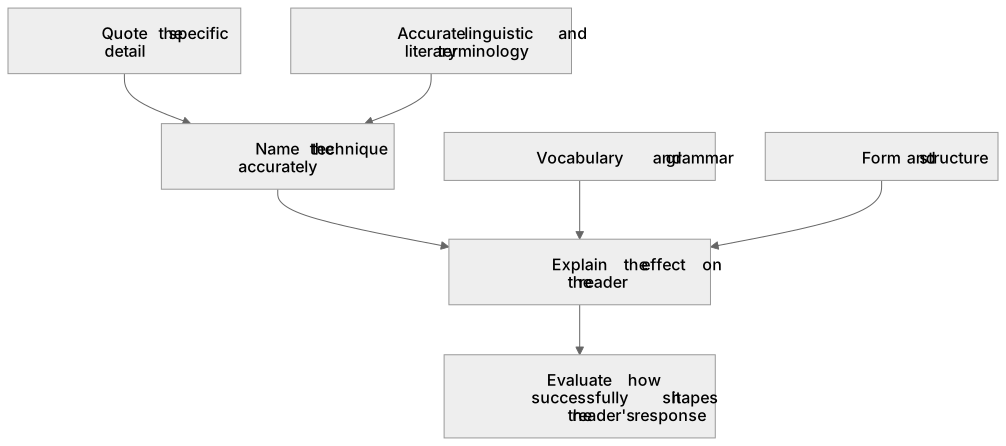
Key words
Say what each word means before you turn the card.
Evaluating language and structure
Try answering aloud or in your head before turning the card.
Using subject terminology precisely
Try answering aloud or in your head before turning the card.
Analysing grammatical impact
Try answering aloud or in your head before turning the card.
Judging effectiveness and reader response
Try answering aloud or in your head before turning the card.
See every definition
- Evaluating language and structure
- Judging how successfully a writer's vocabulary, form, grammatical and structural choices achieve the intended effect on the reader.
- Using subject terminology precisely
- Naming linguistic and literary features accurately, such as noun phrase, imperative verb or cyclical structure, so the term matches the exact choice discussed.
- Analysing grammatical impact
- Explaining and illustrating how specific vocabulary and grammar, such as a verb choice or noun phrase, contribute to effectiveness and impact.
- Judging effectiveness and reader response
- Making informed judgements about how successfully the writer's combined choices shape the reader's response, rather than merely describing them.
Label the diagram
Some boxes have lost their names. Pick the right name for each number.
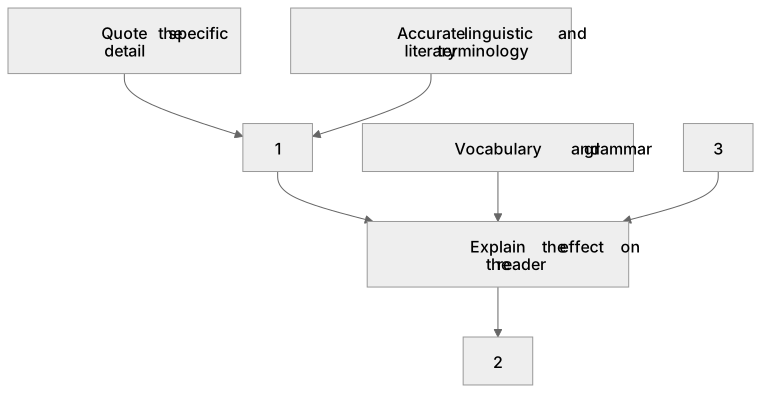
1Box 1
2Box 2
3Box 3
There is more to this lesson
The full lesson goes on to check your understanding and help you earn the marks. Create a free account to carry on, with your progress saved.
A week of Premium from your first lesson · Then the free plan continues · No card, no charge
Test your understanding of Component 1: Fiction and Imaginative Writing - 1.1 Reading: 1.1.4 evaluation of a writer’s choice of vocabulary, form, grammatical and structural features: explain and illustrate how vocabulary and grammar contribute to effectiveness and impact, use linguistic and literary terminology accurately to do so and pay attention to detail; analyse and evaluate how form and structure contribute to the effectiveness and impact of a text
Active recall beats re-reading. Take an instant quiz now to test what you’ve learned and lock it into long-term memory.
A week of Premium from your first lesson · Then the free plan continues · No card, no charge